Adjudication Process
What is Adjudication?
Adjudication is a dispute resolution process that allows Parties to present their dispute to an independent third party for a decision. In an adjudication, the individual or organization wishing to refer a dispute to adjudication (the “Claimant”) and the individual or organization from whom money is alleged to be owing (the “Respondent”) present their dispute to a third party (the “Adjudicator”). The Adjudicator will consider the evidence and make a decision (a “Determination”) within thirty days of the Claimant submitting its supporting documents. If the Adjudicator orders a Party to pay the other Party, the payment must be made within fifteen days of the issuing of the Determination.
Interim adjudication is designed to help workers and businesses to be paid on time for their work and resolve payment disputes.
Some features of Adjudications under the Construction Act are:
- Adjudications are quick. After an Adjudicator receives the Claimant’s documents, the Adjudicator must render a Determination no later than 30 days after receiving the Claimant’s documents (unless the Determination due date is extended);
- Determinations are binding only until a decision is made in a subsequent proceeding. Either Party can commence a proceeding in court or through arbitration. The Determination is binding until a final decision is made in the subsequent proceeding;
- Adjudications are cost-effective. Adjudications are less costly than arbitration and litigation. For further information on costs, please refer to the Schedule of Fees and Fees, Retainers and Payments;
- Adjudication is available as a right. A Party to a construction contract can commence an adjudication without the other Party’s consent; and
- The adjudication process is set by the Adjudicator, as opposed to the process being guided by a set of rules. The Parties can suggest a process to the Adjudicator for consideration, as outlined at Adjudication Process.
Overview of Adjudication Process
Commencement of adjudication:
- The adjudication process commences when the Claimant provides the Respondent with a Notice of Adjudication (and sends ODACC an electronic copy). For further information on how to commence an adjudication, please refer to Commencing an Adjudication.
Adjudicator Selection
An adjudication may only be conducted by a certified ODACC Adjudicator.
Registry Adjudicator:
- The Parties to the adjudication may agree to a Registry Adjudicator or may request that the Authority appoint one (s.13.9(2) of the Construction Act).
- If a Registry Adjudicator to which the Parties have agreed does not consent to conduct the adjudication within four days after the notice of adjudication is given, the Party who gave the notice shall request that the Authority appoint a Registry Adjudicator (13.9(4) of the Construction Act).
- The Authority shall appoint a Registry Adjudicator, subject to his or her consent , to conduct an adjudication no later than seven days after receiving a request for the appointment. For an Adjudicator to be officially appointed to an adjudication, the Adjudicator must accept the appointment to conduct the adjudication (s. 13.9(6) of the Construction Act). Adjudicators have the right to refuse to conduct an adjudication.
Private Adjudicator:
- The Parties to the adjudication may agree to a Private Adjudicator if the prescribed conditions are met. (s. 13.9(2.1) of the Construction Act and s. 21 of O. Reg. 264/25 for prescribed conditions).
The Parties may agree to a Private Adjudicator if,
- (a) there is a written agreement signed by the Parties and the Private Adjudicator that discloses the terms applicable to the adjudication and the adjudicator fee to which they have agreed; and
- (b) the adjudicator fee amounts to an hourly rate of at least $1,000, regardless of how it is charged (s. 21 of O. Reg. 264/25).
Registry Adjudicator or Private Adjudicator:
- If, in the view of the Party giving notice, there is no reasonable prospect of agreement on an Adjudicator (Registry Adjudicator or Private Adjudicator), that party must request that the Authority appoint a Registry Adjudicator. This reinforces the default to Registry Adjudicators when agreement cannot be reached (s. 22 of O. Reg. 264/25).
Response:
- The Respondent may provide the Claimant (and ODACC) with a Response to Notice of Adjudication. For further information on how to respond to a Notice of Adjudication, please refer to Response to Notice of Adjudication.
Adjudication Process:
- The Adjudicator will conduct the adjudication in the manner he or she determines appropriate in the circumstances, in accordance with s. 13.12(4) of the Construction Act. Some adjudications may include a hearing by videoconference, some may require a site visit, and some may proceed only with documents. For further information about the adjudication process, please refer to Adjudication Process.
Negotiating Fees:
- Registry Adjudicator: After a Registry Adjudicator consents to adjudicate a dispute, the Adjudicator will contact the Parties to negotiate the Adjudication Fee. The Adjudication Fee may consist of a flat fee, or an hourly rate (plus disbursements, if applicable). If the Registry Adjudicator and the Parties cannot agree on an Adjudication Fee, the Registry Adjudicator may ask ODACC to set the fee. ODACC will set the fee in accordance with the Schedule of Fees approved by the Attorney General for Ontario. For further information on fees, please refer to the Schedule of Fees and Fees, Retainers and Payments.
- Private Adjudicator: The Parties may agree to a Private Adjudicator if,
- (a) there is a written agreement signed by the Parties and the Private Adjudicator that discloses the terms applicable to the adjudication and the Adjudicator fee to which they have agreed; and
- (b) the Adjudicator fee amounts to an hourly rate of at least $1,000, regardless of how it is charged.
FAQ: Who is responsible for paying the cost of the adjudication?
The Parties to an adjudication shall split payment of the adjudication fee equally, subject to a different determination by the Adjudicator under s.13.17 of the Construction Act (s.13.10(3)). Each Party to an adjudication will be responsible for their own costs, regardless of the outcome (s. 13.16 of the Construction Act) subject to a different determination by the Adjudicator under s.13.17. An Adjudicator has the discretion to order a Party to pay some or all of the other Party’s costs, any part of the adjudication fee amount determined that would otherwise be payable by the other party, or both where the Party acted in a manner that was “frivolous, vexatious, an abuse of process or other than in good faith” in respect of the improvement or of the adjudication (s.13.17 of the Construction Act).
Parties Submit Documents:
- When the Adjudicator communicates the adjudication process to the Parties, the Adjudicator may specify the supporting documents (and number of pages) that each Party may submit to the Adjudicator for consideration. The Claimant’s supporting documents are due no later than five days after the Adjudicator agrees or is appointed to the adjudication. The Adjudicator will notify the Respondent as to when it must submit its supporting documents. For further information on supporting documents, please refer to Supporting Documents.
Determination Due Date:
- The Adjudicator will make a Determination within thirty days from the day the Claimant submits its documents (the “Due Date”). The Due Date may be extended with the consent of all the Parties and the Adjudicator. For further information on Determinations, please refer to Determinations.
Certified Determination:
- ODACC will certify the Determination within seven days of the Determination being sent to the Parties. For further information on certified Determinations, please refer to Determinations.
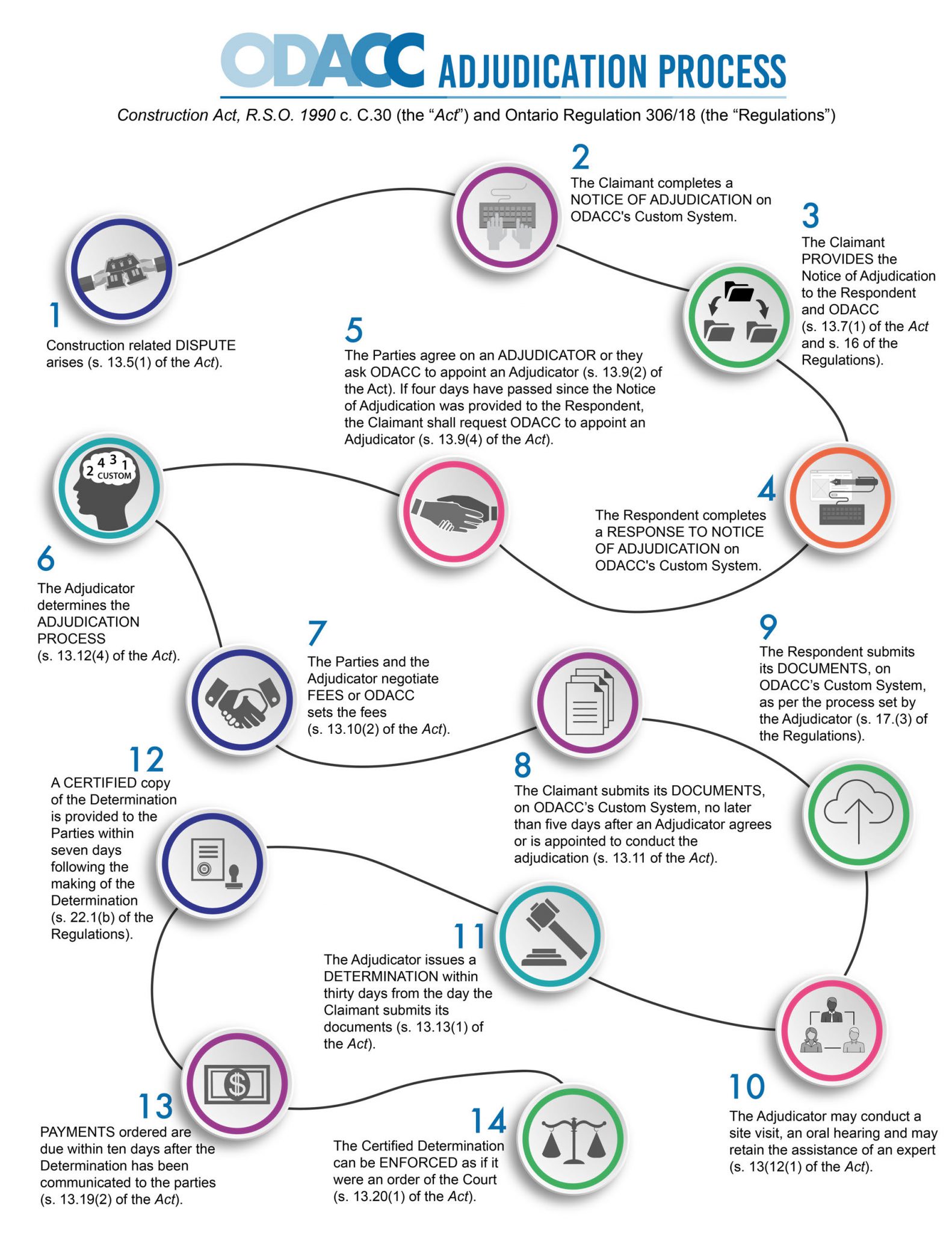
Flowchart of ODACC’s Adjudication Process
Below is a flowchart of ODACC’s adjudication process: